Teacher’s Pet August 3, 2025
Posted by judylobo in Zoo.Tags: American Indian Museum, art, Art exhibit, George Morrison, Metropolitan Museum, Native American, NYC, photography, Rhode Island School of Design, RISD, USPS
add a comment
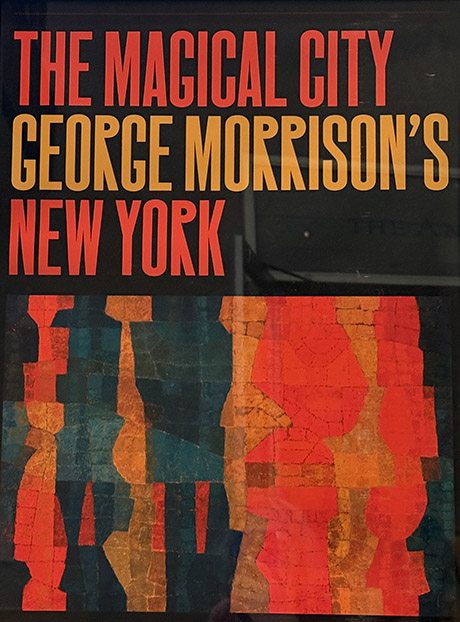 When I was in my Senior year at RISD I was fortunate to have Professor George Morrison as my Painting advisor, teacher, mentor and most of all friend. RISD was/is a small art school and students had many opportunities to grow professionally and personally when we got to know our teachers. I had never met an American Indian before (not unusual if one is born in Brooklyn) so much was new to me about his culture and background. He invited me many times to his house to dine, chat and develop a friendship with not only George, but his wife Hazel and young son Briand. I do wish my memories were more clear some 60 years later but sadly they are mostly faded. What remains is the memory of being so very grateful that I got to know him and we stayed in touch after college but like many things in life time tends to separate people. Whenever I am in DC we go to the American Indian museum to look for his work but was always told they were ‘traveling.’ So imagine my glee to learn that the Metropolitan Museum recently opened an exhibit of his work featuring 35 of his pieces that were created when he lived in NYC as a young man. This wonderful show will be on exhibit thru May of 2026 and can be found in the American Wing. I know I will return to see it again. The U.S. Postal Service honored George Morrison (1919-2000), one of the nation’s greatest modernist artists and founding figure of Native American modernism, with a set of five stamps showcasing his work in April of 2022. And yes, I have a few sheets of the stamps. The title photo features a photo of him and the sheet of stamps.
Indigenous Art July 7, 2024
Posted by judylobo in Zoo.Tags: animals, art, Art exhibit, Cass Gilbert, Indigenous people, Musuem of the American Indian, Native American, NYC, photography, Smithsonian
2 comments
 I took a three mile walk south via Broadway to the Smithsonian National Museum of the American Indian. I haven’t been to that beautiful building (formerly the Custom House designed by Cass Gilbert in 1907) in a very long time. A diverse and multifaceted cultural and educational enterprise, the National Museum of the American Indian is an active and visible component of the Smithsonian. The Museum cares for one of the world’s most expansive collection of Native artifacts, including objects, photographs and archives covering the entire Western Hemisphere, from the Arctic Circle to Tierra del Fuego. The bottom four photos are contemporary pieces seen in a wonderful display on the ground floor. I highly recommend a visit. It is free and open daily from 10 to 5.
My Native American Name July 30, 2023
Posted by judylobo in Zoo.Tags: art, Art exhibit, Jaune Quick-to-See Smith, Native American, NYC, photography, Whitney Museum
4 comments
 I was finally feeling a bit better post surgery and (sort of) ran to the Whitney Museum to see this exhibit. It closes August 13th and if you can get there, I highly recommend it. I was not familiar with her work but happy to finally explore and adore it. I also love her name. If I were Native American I would like my name to be ‘Raised by Wolves’. Jaune Quick-to-See Smith (born 1940) is a Native American visual artist and curator. She is an art educator, art advocate, and political activist. She has been prolific in her long career, and her work draws from a Native worldview and comments on American Indian identity, histories of oppression, and environmental issues.This exhibition is the first New York retrospective of Jaune Quick-to-See Smith, citizen of the Confederated Salish and Kootenai Nation), an overdue but timely look at the work of a groundbreaking artist. Jaune Quick-to-See Smith: Memory Map brings together nearly five decades of Smith’s drawings, prints, paintings, and sculptures in the largest and most comprehensive showing of her career to date. Her artistic traditions are incorporated and reimagined with concepts rooted in Smith’s own cultural practice, reflecting her belief that her “life’s work involves examining contemporary life in America and interpreting it through Native ideology.” Employing satire and humor, Smith’s art tells stories that flip commonly held conceptions of historical narratives and illuminate absurdities in the formation of dominant culture. Smith’s approach importantly blurs categories and questions why certain visual languages attain recognition, historical privilege, and value.
 While at the Zoo